
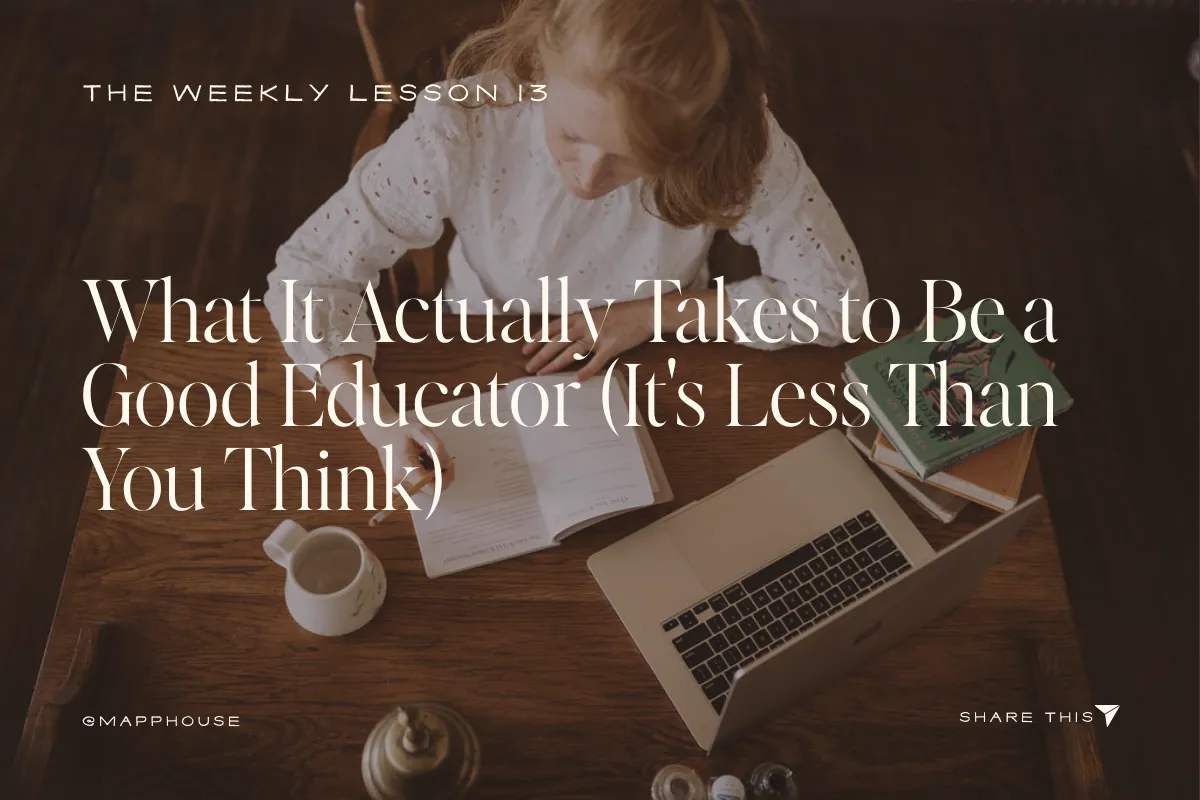
What It Actually Takes to Be a Good Educator (It's Less Than You Think)
You don't need a teaching degree to be a good educator.
You don't need a perfectly scripted lesson, a polished delivery, or a decade of classroom experience. You don't need to have every answer. You don't need to be flawless.
Here's what you actually need, and it's probably simpler than you've been telling yourself.
1. Care about your students.
Not in a performative way. In the real way. The way you already care about your clients, your patients, your people. The thing that made you choose this work in the first place, that's your foundation as an educator. It already exists in you.
2. Know just a little more than they do.
You don't need to be the world's foremost authority on your subject. You need a baseline edge, call it the 10% rule. You know more than your student knows right now. That's enough to lead them forward. The rest builds as you go.
3. Show up. Even imperfectly.
This is the one most people stumble on. The desire and willingness to be present, to hold a room, to say I belong here, I have something to give, that is the work. And yes, sometimes you will fumble. You will say the wrong thing or take a wrong turn. You own it. You move on. That moment of "I was wrong, here's what we can learn" is often where the deepest teaching happens.
Teaching moments don't only come from polished, beautiful lessons. They come from the raw ones too.
The shift that's harder than it looks.
For professionals who were trained to be the expert — the therapist, the practitioner, the specialist — adding educator to your identity can feel like a lot. There's a weight to the word. A sense of expectation. A quiet voice asking: who am I to teach this?
But here's the truth: your students are not looking for a perfect teacher. They are looking for a guide they trust. Someone who cares about them, knows their subject, and shows up consistently.
You are already that person.
Voice is trust. And trust is built not through perfection, but through confidence, compassion, passion for what you teach, and the willingness to bring yourself — your stories, your experience, your personality — into the room.
That's what makes education stick.
That's what makes students stay.
Cheers, Kim
Ready to build your course or program with clarity from the start? Book a Strategy Session and let's map your message, your audience, and your boundaries together.
Or if you're just exploring how to bring your expertise online, book free Office Hours to talk through where to begin.